
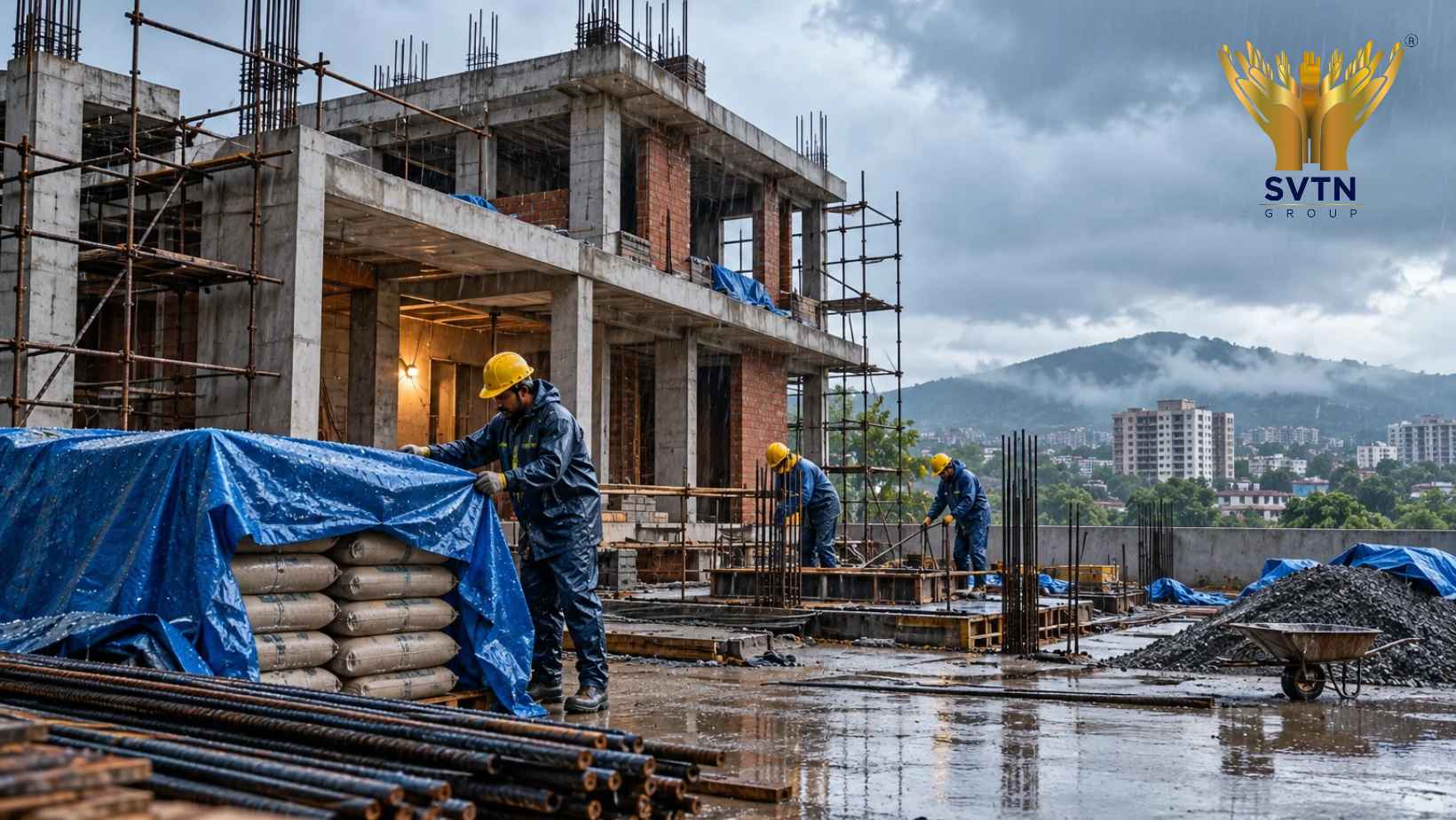
Building a house in Pune comes with its own set of challenges. The weather is one of them. Pune’s monsoon can bring heavy rainfall, water accumulation, high humidity and sudden changes in site conditions. For a construction project, that means the approach to excavation, material storage, concrete work, waterproofing, electrical work and site safety may need additional attention.
But does that mean you should stop construction completely during the monsoon? Not necessarily. House construction can continue during the rainy season when the work is properly planned and site conditions are suitable. However, not every activity can be treated the same way.
Some work needs protection. Some needs additional quality checks. And certain activities may need to be rescheduled depending on rainfall and ground conditions.
If you’re planning house construction in Pune, understanding these considerations can help you plan your project more realistically.
Can You Build a House in Pune During the Monsoon?
Yes, house construction can continue during the monsoon, but the construction strategy may need to change.
Rain doesn’t automatically make construction impossible.
The bigger concern is how the site is managed when rain affects soil, access, materials and ongoing work.
For example, heavy rainfall can create water accumulation around an excavation. Wet construction materials can create quality and storage issues. Poor site drainage can make movement difficult. Fresh concrete and unfinished surfaces may also require appropriate protection.
This is why an experienced construction team doesn’t simply follow the same routine regardless of weather.
The work needs to be planned around the site conditions.
Why Does Monsoon Require Special Attention During House Construction?
A house under construction is very different from a completed building.
Once a home is finished, the roof, walls, drainage systems, windows and waterproofing protect the interior. During construction, many of these protective layers don’t exist yet.
An excavation may be open. Reinforcement may be exposed. Walls may not have their final finishes. Electrical conduits may be incomplete. Materials may be stored temporarily on site.
Rain can therefore affect different stages of construction in different ways.
The solution isn’t to panic every time it rains.
It’s to anticipate where rain can create a problem and plan accordingly.
1. Start With Proper Site Drainage
One of the first things to consider during monsoon construction is:
Where will the rainwater go?
Water should not be allowed to accumulate around the construction area unnecessarily.
Before and during construction, the site team may need to plan temporary drainage paths, pumping arrangements or other measures appropriate to the site.
This becomes particularly important when:
- The plot is at a lower level than the road
- The site has poor natural drainage
- Excavation is underway
- The surrounding area experiences water accumulation
- The plot has a slope
Good site drainage isn’t glamorous.
But during monsoon, it can make a significant difference to how smoothly a project operates.
2. Excavation and Foundation Work Need Extra Care
Foundation work involves soil excavation, footing preparation and other activities that can be affected by excess water.
Heavy rain can cause:
- Water accumulation in excavated areas
- Soil softening
- Slippage or collapse of excavation sides
- Difficulty in maintaining levels
- Delays in reinforcement and concreting
The correct response depends on the soil, depth of excavation, site conditions and construction stage.
If an excavation fills with water, simply removing the water and continuing without checking the condition of the excavation may not be appropriate.
The site should be assessed before proceeding.
This is one reason why site supervision matters, particularly during unpredictable weather.
3. Protect Cement and Other Construction Materials
Construction materials need proper storage throughout the year, but monsoon makes storage even more important.
Cement, for example, needs to be protected from moisture.
Other materials also need suitable storage and handling.
A well-managed site should have arrangements to protect materials from:
- Direct rain
- Ground moisture
- Water accumulation
- Mud
- Unnecessary exposure
Materials should not simply be left wherever there is available space.
Good storage reduces wastage and helps maintain the expected quality of the construction.
4. Concrete Work Needs Weather-Aware Planning
Concrete is one of the most important parts of structural construction, so rain during concreting needs careful attention.
The question isn’t simply:
“Can concrete be poured when it’s raining?”
The more useful question is:
“Are the site and weather conditions suitable for this particular concreting activity, and can the work be properly protected and controlled?”
Rainwater should not be allowed to unintentionally alter the concrete mix or interfere with the placement and finishing process.
Freshly placed concrete may also require protection from direct rainfall depending on the conditions and stage of work.
Concrete work should therefore be planned with the weather forecast and site conditions in mind.
5. Don’t Treat RCC Work Like a Race Against the Rain
RCC construction requires coordination between reinforcement, formwork, concrete placement, finishing and curing.
During monsoon, every stage needs proper attention.
Before concreting, the team should ensure that:
- Reinforcement is correctly positioned
- Formwork is stable
- The area is properly prepared
- Water accumulation is controlled
- Required materials and equipment are ready
- Weather conditions are considered
The objective should never be to complete an RCC activity simply because it was scheduled for that day.
Quality and safety should determine whether the work proceeds.
6. Brickwork and Blockwork May Need Adjustments
Masonry work can also be affected by wet conditions.
Excess moisture can influence handling, workability and subsequent finishing requirements depending on the materials and construction method being used. The site team needs to understand the condition of the materials and substrate before continuing.
This is especially important when construction is moving quickly from masonry to plastering.
A rushed schedule during monsoon can create problems that only become visible much later.
7. Plastering Needs the Right Conditions
Plastering is another activity where weather conditions matter.
Rain and excessive moisture can interfere with drying and finishing.
External plastering is particularly exposed to weather.
Instead of asking whether plastering can be done during monsoon as a simple yes-or-no question, the better approach is to consider:
- Current rainfall
- Surface condition
- Moisture
- Protection available
- Expected weather
- Type of plastering work
The construction team should decide whether conditions are suitable for the specific activity.
8. Waterproofing Should Never Be an Afterthought
If there is one area homeowners should pay particularly close attention to, it is waterproofing.
A monsoon can quickly expose weak points in a building envelope.
Waterproofing may be required in areas such as:
- Terrace
- Bathrooms
- Balconies
- Wet areas
- Sunken portions
- Basement areas, where applicable
- External surfaces
But waterproofing isn’t simply about applying a product.
Surface preparation, detailing, joints, drainage slopes, application and testing all matter.
For a homeowner, the important question isn’t:
“Is waterproofing included?”
Ask:
“Where is waterproofing included, what system is being used, how is it being executed, and how will it be checked?”
9. Protect Electrical Work From Water Exposure
Construction sites contain temporary electrical connections, tools, equipment and partially completed electrical systems.
Rain increases the importance of electrical safety.
Temporary electrical installations should be properly managed, protected and inspected by competent personnel.
During construction, avoid treating exposed wiring, temporary connections or wet areas casually.
Once permanent electrical work is installed, the team should also ensure that conduits, boxes and other components are appropriately protected until the relevant finishing stages are complete.
Electrical safety should always take priority over maintaining a construction schedule.
10. Plan Construction Material Deliveries Carefully
Rain doesn’t only affect the construction work itself.
It can also affect logistics.
A material delivery may become difficult when:
- Roads are waterlogged
- Site access is muddy
- Heavy vehicles cannot reach the plot
- Storage areas are inaccessible
- Materials cannot be safely unloaded
This is where project planning becomes important.
Materials that are required for upcoming work should be planned in advance, while unnecessary stockpiling should also be avoided.
The goal is to maintain the construction flow without turning the site into an unsafe or poorly organised storage area.
11. Site Access and Worker Safety Become More Important
A wet construction site can become slippery and difficult to navigate.
Open excavations, scaffolding, electrical equipment, stacked materials and muddy access routes can create additional hazards.
During monsoon, the site team should pay particular attention to:
- Safe access
- Excavation protection
- Scaffolding
- Electrical safety
- Material stacking
- Water accumulation
- Slippery surfaces
- Visibility during poor weather
Construction should never continue simply to meet a deadline if the site isn’t safe.
12. Don’t Rush the Construction Schedule
This is perhaps the biggest lesson for homeowners.
Rain may slow certain activities. That’s not necessarily a sign of poor project management. A responsible construction team should distinguish between a genuine weather-related delay and a delay caused by poor planning.
For example, if heavy rainfall makes a particular activity unsuitable, postponing it may protect the quality of the project. The better approach is to use suitable days for weather-sensitive work and keep other activities moving wherever possible.
Good construction planning is about managing the sequence, not pretending weather doesn’t exist.
Which Construction Activities Can Continue During Monsoon?
Not every activity is equally affected by rain.
Depending on the site and conditions, teams may continue with activities such as:
- Internal preparation work
- Material procurement
- Electrical planning
- Plumbing preparation
- Certain internal finishing activities
- Fabrication work
- Design coordination
- Quality inspections
- Measurement and documentation
Weather-sensitive activities may require additional precautions or rescheduling.
The exact decision should be made based on actual site conditions rather than a fixed rule that applies to every project.
What Should Homeowners Do During Monsoon Construction?
You don’t need to become a civil engineer to monitor your project.
But you should ask the right questions.
For example:
How is rainwater being managed at the site?
How are materials being stored?
Is the excavation protected?
What work is being postponed because of rain?
How is the construction schedule being adjusted?
What waterproofing checks are being performed?
These questions can give you a much better understanding of how your project is being managed.
Does Monsoon Increase House Construction Cost in Pune?
It can, depending on the project.
Weather-related costs may arise from:
- Additional site protection
- Water removal
- Temporary drainage
- Material protection
- Labour inefficiencies
- Logistics challenges
- Rescheduling
- Extended project duration
However, there isn’t one fixed “monsoon surcharge” that applies to every house.
A well-planned project can reduce avoidable costs through proper scheduling, procurement and site management.
This is why homeowners should look at the overall construction plan, rather than assuming that every monsoon delay automatically means a major cost increase.
Should You Start House Construction Just Before the Monsoon?
There is no universal answer. It depends on the project stage, plot condition, approvals, design readiness, contractor availability and expected weather conditions. If you start a project just before heavy rainfall, you may find yourself dealing with excavation and foundation work during challenging conditions. On the other hand, delaying a project solely because the calendar says “monsoon” may not always be necessary.
The more sensible approach is to understand: What stage will the project reach when the monsoon arrives? That question is much more useful than simply asking whether monsoon is a good or bad time to build.
Monsoon Construction: What Should You Look for in a Construction Company?
This is where choosing the right construction partner becomes important.
A Best Construction Company in Pune should not be defined only by its portfolio or quoted construction rate.
For a homeowner, project management capability matters too.
Ask how the company handles:
- Rain-related site management
- Material storage
- Construction scheduling
- Waterproofing
- Quality inspections
- Site safety
- Procurement
- Weather-related delays
- Communication with homeowners
You want a construction team that understands that the project exists in the real world—not in a spreadsheet where every activity happens exactly on schedule.
Why Experience Matters During Monsoon Construction
Construction methods may look straightforward on paper.
But actual site conditions can change quickly.
A sudden rainfall can affect excavation. A wet access road can delay a material delivery. Water accumulation can change the condition of the site.
An experienced team knows that the response should be based on the actual situation.
That means inspecting the site, communicating the issue, adjusting the sequence where necessary and documenting important decisions.
For homeowners, this kind of experience can be more valuable than simply finding a contractor who promises the fastest completion date.
8 Questions to Ask Your Construction Company Before Monsoon
Before the rainy season begins, ask your construction team:
How will rainwater be drained from the site?
How will cement and other materials be protected?
What happens if excavation fills with water?
Which activities may be affected by heavy rainfall?
How will the construction schedule be adjusted?
What precautions are being taken for electrical safety?
How is waterproofing being planned and checked?
How will weather-related changes be communicated to me?
You don’t need complicated technical answers.
You need clear answers and a clear plan.
A Practical Monsoon Construction Checklist
Before and during the rainy season, homeowners should make sure the project team has considered:
- Site drainage
- Excavation protection
- Material storage
- Cement protection
- Concrete work
- RCC scheduling
- Waterproofing
- Electrical safety
- Safe site access
- Scaffolding
- Material deliveries
- Construction sequencing
- Quality inspections
- Weather-related schedule adjustments
The purpose of this checklist isn’t to stop construction.
It is to make construction more controlled and predictable when weather conditions become unpredictable.
How SVTN Group Approaches Construction During Pune’s Monsoon
At SVTN Group, we believe construction planning should account for the actual conditions of the project—not just the ideal schedule.
For homeowners, monsoon management is about more than deciding whether workers should be on site.
It involves looking at the complete picture: site drainage, material storage, construction sequencing, quality, safety, waterproofing and communication.
As a construction company in Pune, the objective is to keep suitable work moving while taking appropriate precautions when weather affects a particular activity.
Because building a home isn’t about finishing every stage as quickly as possible.
It’s about completing every stage properly.
Frequently Asked Questions
Can house construction continue during monsoon in Pune?
Yes. Construction can continue during the monsoon, but weather-sensitive activities may require additional precautions, rescheduling or protection depending on actual site conditions.
Is monsoon a bad time to build a house?
Not necessarily. The impact depends on the construction stage, site conditions, drainage, planning and the type of work being carried out.
Can foundation work be done during monsoon?
Foundation work can be carried out during suitable conditions, but excavation, soil stability, water accumulation and dewatering need careful attention.
Can RCC work be done during rain?
RCC work requires appropriate weather and site conditions. Rain should not be allowed to compromise concrete placement, finishing or quality. The site team should assess conditions before proceeding.
How does rain affect house construction?
Rain can affect excavation, material storage, concrete work, masonry, plastering, site access, logistics, safety and project scheduling.
How should cement be stored during monsoon?
Cement should be kept protected from rain and ground moisture in appropriate storage conditions. Proper handling helps prevent unnecessary material deterioration and wastage.
Does monsoon increase construction costs?
It can in some projects because of additional site protection, drainage, logistics challenges, rescheduling or extended project duration. The impact varies from project to project.
Can waterproofing be done during monsoon?
Waterproofing work depends on the specific system, surface condition and weather. Many waterproofing applications require suitable dry conditions, so timing and execution need to be planned carefully.
How can I prevent waterlogging at my construction site?
Proper site grading, temporary drainage arrangements, water removal systems and planned runoff paths can help manage rainwater. The right solution depends on the site’s levels and surrounding drainage conditions.
What should I look for when choosing a construction company in Pune?
Look beyond the quoted price. Consider the company’s experience, construction planning, quality processes, site supervision, material management, communication, safety practices and ability to handle site-specific challenges such as monsoon conditions.
Conclusion
Monsoon doesn’t have to bring your house construction project to a complete stop.
But it does demand better planning.
The key is understanding that different construction activities respond differently to rain. Excavation needs one type of attention. Concrete work needs another. Material storage, waterproofing, electrical safety and site access all have their own considerations.
For homeowners, the most important thing is not to expect construction to continue blindly according to a fixed calendar.
Instead, work with a team that can assess site conditions, adjust the sequence when necessary and keep quality and safety at the centre of the project.
If you’re planning to build a home in Pune, discuss the monsoon strategy before construction begins.
Because good construction isn’t just about knowing how to build a house.
It’s knowing how to build it properly—even when the weather doesn’t cooperate.